
Trollhättefallen (the troll’s hat waterfall), one of Sweden’s most dramatic waterfalls, has long been a significant site for harnessing hydroelectric power. The dam and the industrial development around it have transformed the area, yet Carl Eldh’s sculpture and the myth of Strömkarlen remains as a caution about the complexity of nature’s exploitation.
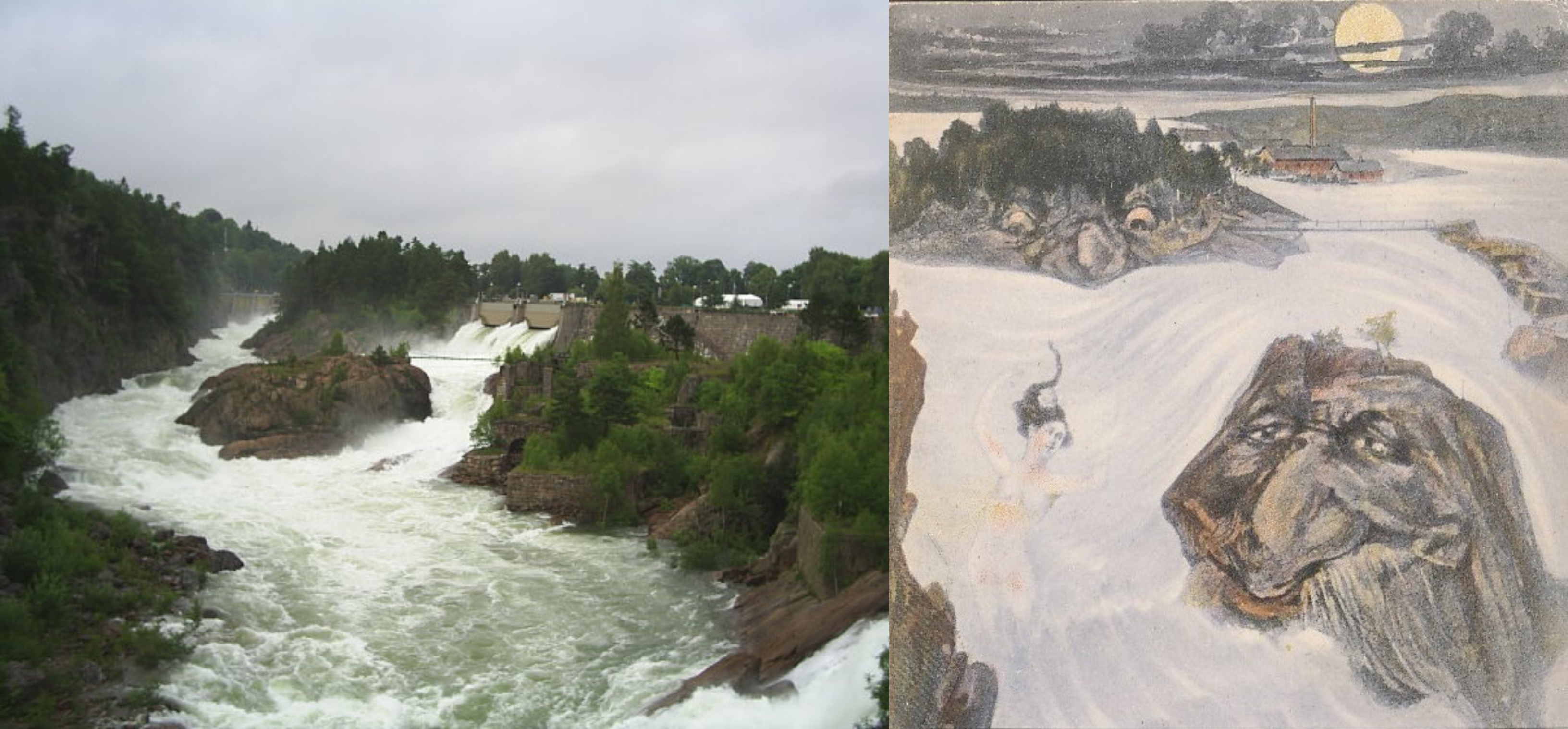
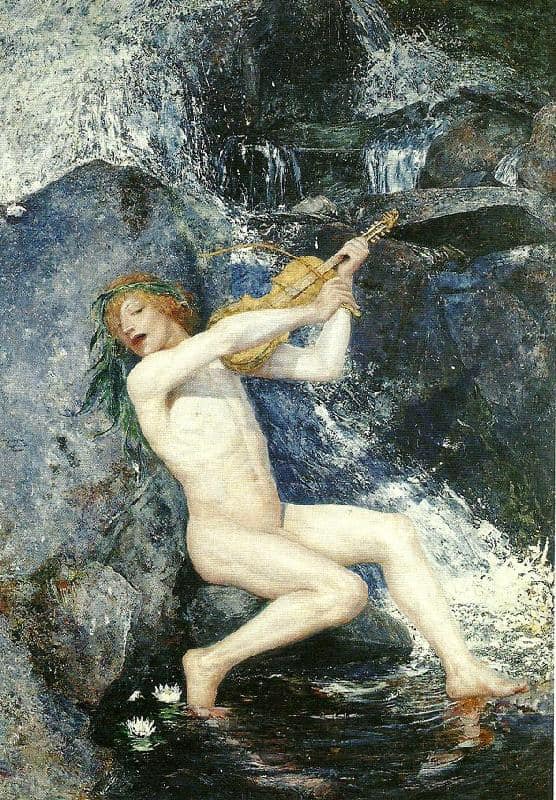
In the heart of Swedish folklore, nestled deep in the woods and rushing rivers, resides a mystical figure known as Strömkarlen. Often depicted as a male water spirit, Strömkarlen is renowned for his unparalleled skill with the fiddle, a talent so enchanting that it could make the waters swirl and dance, and even lure the listener into a trance. This legendary figure has captured the imagination of generations, blending beauty, danger, and the mystical power of nature in one captivating form.

The Legend of Strömkarlen
Strömkarlen, also known as the Näcken in other parts of Sweden, is traditionally associated with rivers, lakes, and waterfalls. According to legend, he is a skilled fiddler whose melodies are both mesmerising and haunting. His music could lure anyone who listens too closely, drawing them towards the water’s edge—often to their doom. Some tales warn of unsuspecting victims who were pulled into the depths after falling under the spell of Strömkarlen’s eerie tunes.
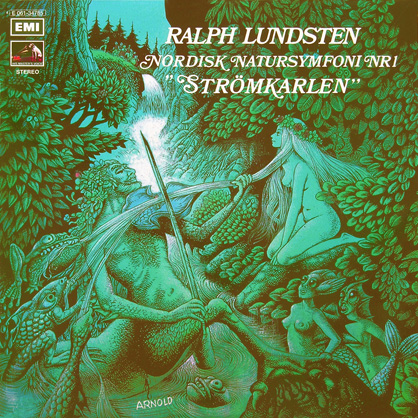
Yet, Strömkarlen is not entirely malevolent. In some stories, he offers his gift of music to those willing to pay a price. If a person seeks him out and makes an offering—whether in the form of a black lamb, coins, or their own blood—the water spirit may grant them extraordinary musical abilities. However, this pact is risky, as it might come with unforeseen consequences, including madness or death.


Though primarily a figure of cautionary tales, Strömkarlen also embodies the awe and respect that Scandinavians have long held for nature, particularly the wild forces of water. The rivers and waterfalls, so crucial to life and industry, were often viewed as sacred or dangerous places that were believed to be under the influence of spirits like Strömkarlen.
Carl Eldh’s Sculpture of Strömkarlen
The legend of Strömkarlen has endured through the ages, finding its way into nineteenth-century Swedish art and culture. Although the water sprite embodied a grave sense of danger, it is no wonder that he featured when Scandinavian waterfalls began to be exploited for the production of hydroelectricity.
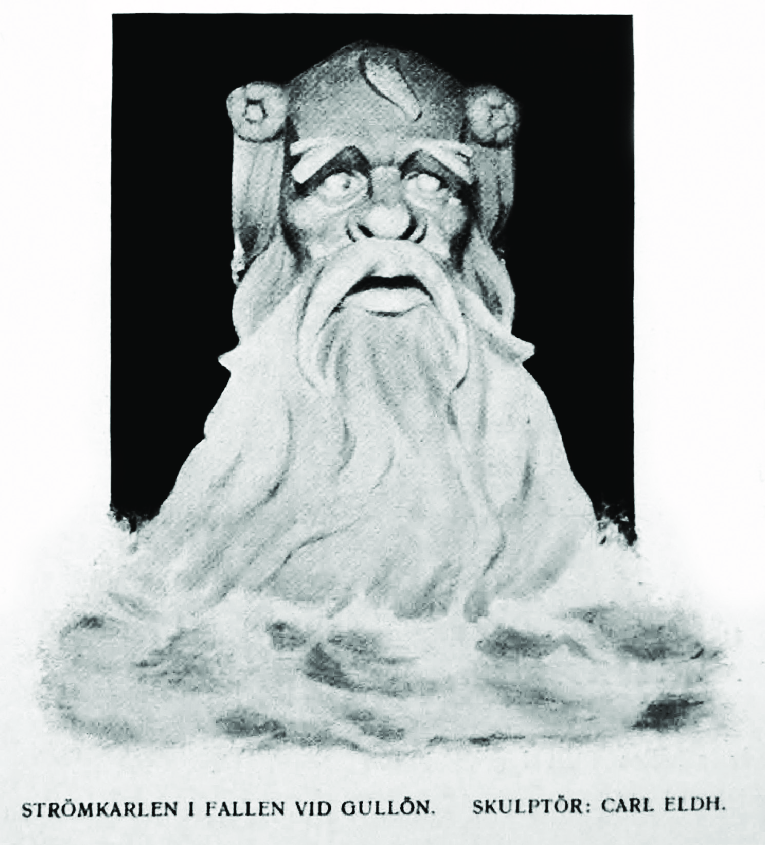
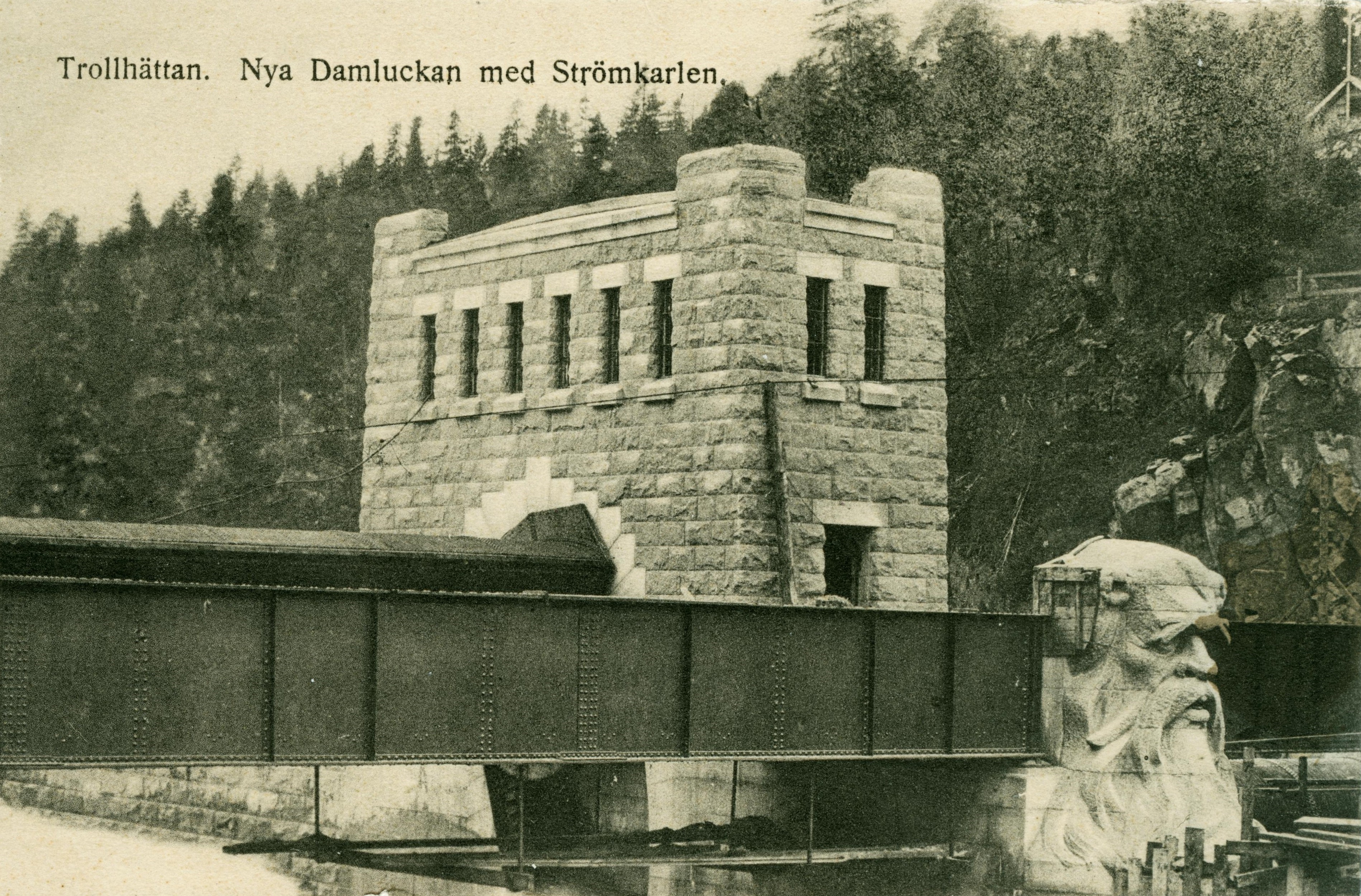
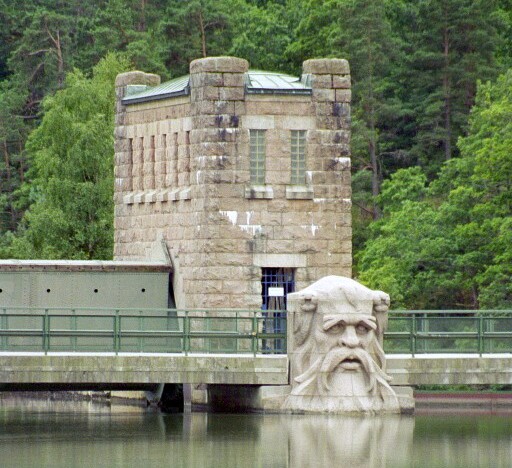
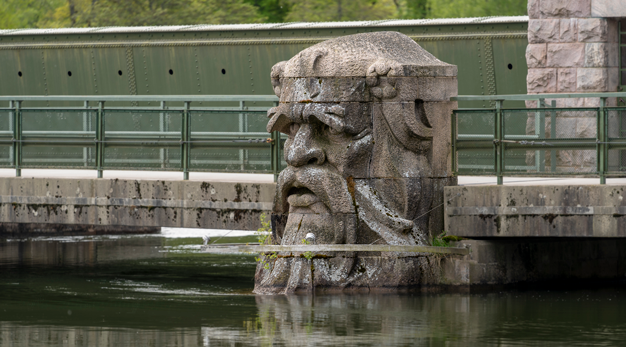
One notable tribute is the four-meter-high granite sculpture of Strömkarlen that emerges out of the water in the centre of Strömkarlsbron (the “Bridge of Strömkarlen”), which crosses the Göta River in Trollhättan, southern Sweden. The bridge was built in 1908 and functions as a regulation dam, harnessing the power of the Trollhättefallen waterfalls, which adds a fitting sense of grandeur and symbolism to the location of the sculpture.

The sculpture was modeled by sculptor Carl Eldh (1873-1954) based on the drawings by architect Erik Josephson (1864-1929) and manufactured by AB Hilleviken outside Stockholm.
“Placed at the dam weirs, a large sculpture designed by Erik Josephson and executed by the sculptor Carl Eldh embodied a ‘giant water sprite surfacing out of the water masses, who bears on his shoulders the bridge that is united here over the river’. This was Josephson’s own description of the sculpture, which was named Strömkarl (Water Sprite)” (Source: Fabian Zimmer, Nature, Nation and the Dam. Narratives about the Harnessed Waterfall in Early Twentieth-Century Sweden, 2019).
‘Statens kraftverk vid Trollhättan’
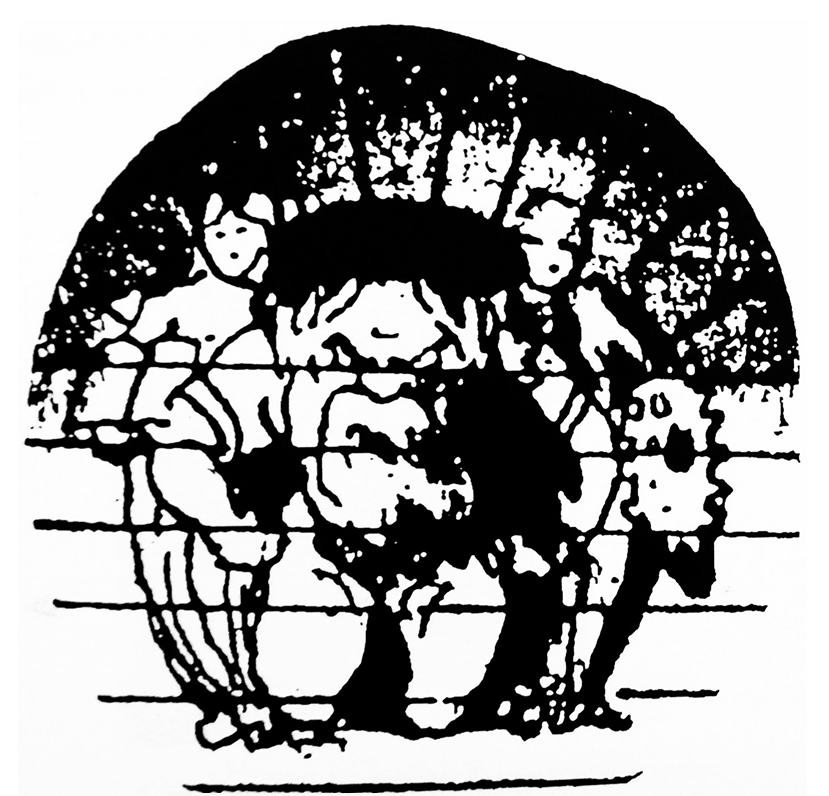
“According to one local historian, the sculpture soon went by the nickname ‘victory monument’ among the people of Trollhättan [a monument to the victory of mankind over wild nature]. This interpretation was quite in line with a sculpture draft found in Josephson’s earlier designs that was to decorate the machine hall’s central projection and that depicted ‘the natural force, bound by science and industry’. Science and industry were depicted as two female figures with one holding a book [science] and the other a cogwheel [industry]. The females other arm restrained an ogre-like figure between them with a face that certainly resembled the Strömkarl sculpture which was eventually executed.” (Source: Fabian Zimmer, Nature, Nation and the Dam. Narratives about the Harnessed Waterfall in Early Twentieth-Century Sweden, 2019).
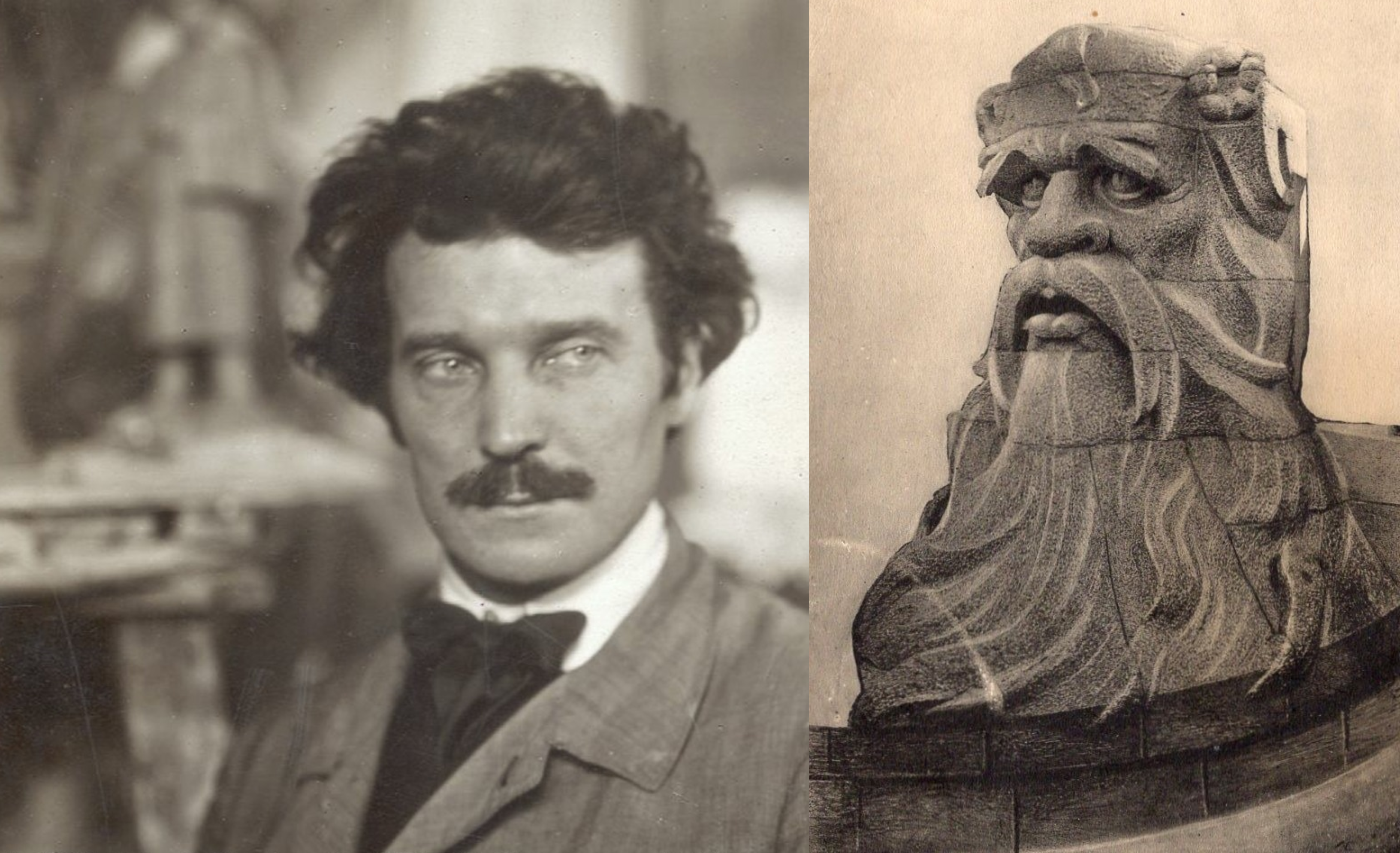
Carl Eldh was one of the most employed sculptors in Sweden during the first part of the twentieth century. At the age of 19, he began his education at the Technical School (Konstfack) in Stockholm. During the study years 1897–1904 at the Académie Colarossi in Paris, he supported himself as a wood carver, among other things. At the World Exhibition in Paris in 1900, he represented Sweden with the sculpture “Virginity”.
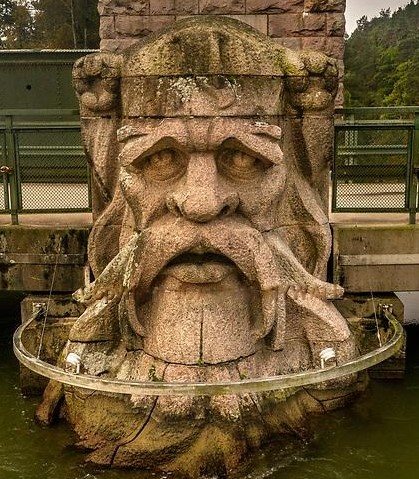
Eldh’s depiction of Strömkarlen changed from Josephson’s original design. His sculpture simulates Strömkarlen’s head rising out of the water. The face is characterised by an intense, almost stern expression, with deep-set snake eyes that seem to gaze out over the flowing waters. The exaggerated contours of his facial features, including his bushy eyebrows, broad nose, and especially the flowing, tangled beard, evoke a sense of his connection to the powerful forces of nature—particularly the water beneath him. This depiction reinforces the folklore that Strömkarlen is a being who belongs to the river itself. The rugged texture of the granite adds to the raw, ancient feel of the sculpture, symbolising strength and permanence. It consists of about 20 granite boulders and has a weight of 60 tons.
“Interpreting Carl Eldh’s sculpture simply as a more refined version of the original design overlooks the details in Josephson’s description of the sculpture that characterised the water sprite as a ‘surfacing giant’, not quite fitting the imagery of a defeated natural force.
The Water Sprite in Scandinavian folk tales was mostly found near running water or under bridges, embodying the unbound forces of water. According to Jochum Stattin’s ethnological analysis of the figure, it was a creature that had a mediating position between nature and man, appearing in moments of conflict or crossing boundaries. It guided, and sometimes influenced, how people behaved towards nature and certain cultural prohibitions related to the natural world.
For instance, in many tales the water sprite would appear at a mill and block the water flow or even destroy the installations if the miller dared to grind flour on a holiday. Intriguingly, the Strömkarl sculpture in Trollhättan was placed at the base of a guard room from which the water levels in the Göta Älv were supervised and where discharge into the old riverbed (and past the power plant) was regulated.
In doing so, Josephson charged the human guardsman’s occupation with allegorical meaning: just like the water sprite, he would mediate between the force of the water and human demands. Additionally, the sculpture was placed precisely at the point where the Göta Älv first left its natural course and transgressed the border into a man-made riverbed.
Whatever the precise meaning that Josephson intended here, it is clear that the interpretation as a ‘victory monument’ certainly does not do the interconnected elements any justice. We may rather assume with art historian Lasse Brunnström that the Strömkarl must be understood as a ‘caution about the complexity of nature’s exploitation’. (Source: Fabian Zimmer, Nature, Nation and the Dam. Narratives about the Harnessed Waterfall in Early Twentieth-Century Sweden, 2019).
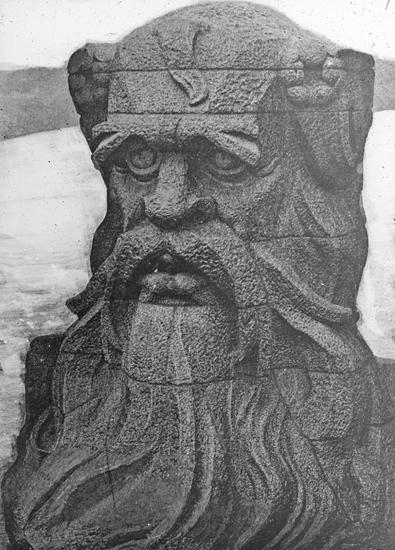
The message highlights the intricate and often unpredictable consequences of exploiting natural resources. Suggesting that interfering with nature for human gain—whether through industrial development, resource extraction, or environmental manipulation—can lead to unforeseen challenges, risks, or imbalances. Emphasizing the need for careful consideration and respect when dealing with nature’s systems.


The Role of Water and Music in Swedish Culture
Strömkarlen’s association with water and music ties into larger themes in Swedish folklore and culture. Sweden’s many lakes and rivers have always played a crucial role in the country’s livelihood, particularly in regions like Trollhättan where water was used for both transportation and industry. However, these same waters were unpredictable and deadly, creating an undercurrent of fear and reverence that appears in many Swedish tales.
Music, especially folk music, is another key aspect of the Strömkarlen myth. The fiddle, central to Swedish folk traditions, carries deep cultural significance. In many rural communities, the fiddle was not only an instrument of joy and dance but also believed to possess mystical properties, capable of calling forth spirits or controlling animals. The fiddle’s association with the otherworldly further enhances Strömkarlen’s image as a mysterious, supernatural figure.
Modern-Day Reflections on the Strömkarlen Myth
Today, the sculpture of Strömkarlen on Strömkarlsbron serves as both a reminder of Sweden’s rich folklore and a connection to its natural landscape. As Trollhättan continues to develop, the sculpture symbolizes the balance between harnessing the power of nature and respecting its ancient mysteries. Tourists and locals alike can pause to admire the sculpture, reflecting on the haunting stories of Strömkarlen that have been passed down through the generations.
Strömkarlen is much more than just a story of a water sprite with a fiddle. He represents the powerful forces of nature, the deep connection between music and magic, and the eternal tension between humans and the natural world. Through Carl Eldh’s sculpture, this enchanting spirit gazes out at the strong current the flows beside him, a tribute to the unseen forces that shape our world.
As long as rivers flow and the wind hums through the trees, the legend of Strömkarlen will endure, a reminder that even in the modern world, some mysteries remain unsolved and some forces remain untamed.
About the Author
For more articles visit Dayne’s Discoveries Blog, browse our online shop, or contact us to share information, stories, or photographs relating to Strömkarlen.

 Dayne's Discoveries